
State Street’s fifth annual Private Markets Study, based on a survey of 480 senior executives across assets owners, investment managers, and private markets specialists offers a current picture of where the money actually sits and where it is headed next. The study has grown considerably since its first edition in 2022, when it surveyed just 170 respondents across North America, Europe, and Japan; today it spans the Americas, EMEA, and APAC, reflecting how central private markets have become to institutional portfolios worldwide.
The credibility behind these numbers matters. State Street’s Private Capital Indices track more than 4,000 primary private equity limited partners, representing roughly $5.7 trillion in capital commitments, built on actual daily cash flows rather than self-reported estimates.
The Global Pie
Among the survey’s regional samples, Europe leads at $10.4 trillion, narrowly ahead of North America’s $9.97 trillion, with APAC at $4.3 trillion, Latin America at $1.1 trillion and the Middle East at $1.7 trillion. Europe’s edge is notable given it is often seen as the more cautious market, and it currently trails North America badly on retail-vehicle adoption (34% vs 53%) but has simply accumulated more institutional scale over time.
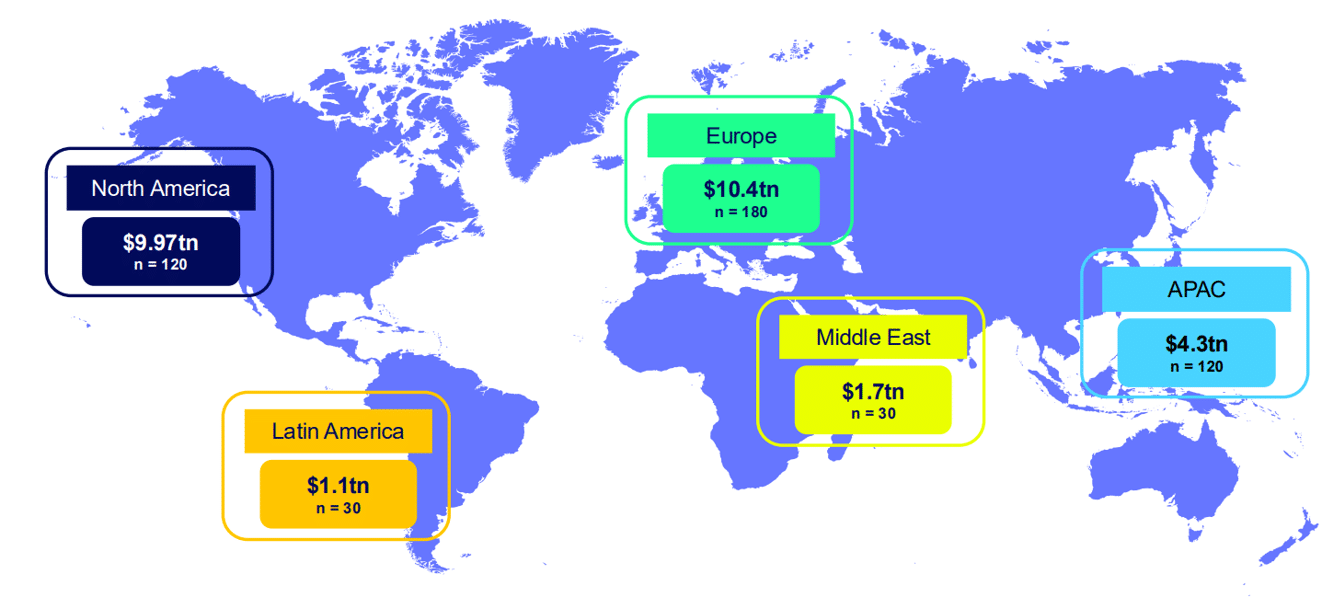
Estimated aggregate AUM of survey sample
Resilience, Not Retreat
So why are people pulling their money out of private markets? Mostly, they aren’t. Respondents in the survey, a mix of limited partners (55.6%), general partners (41.7%), and direct owners (2.7%), paint a picture of steady conviction rather than exodus. Just 7% of asset owners plan to reduce their private markets exposure over the next two years, while a full 50% plan to increase, and 43% plan to hold steady. The reasoning behind that conviction is this: 82% of institutions cite higher expected long-term returns as their main driver for increasing allocations, well ahead of volatility reduction and yield enhancement as secondary motivations. Interestingly that math shifts by region: EMEA asset owners whose private credit market has expanded rapidly in recent years, weight yield considerably more heavily than their peers elsewhere, suggesting an income-focused mindset rather than a purely growth oriented one. Where hesitations exist, it is concentrated around specific operational pain points rather than doubts about the asset class itself. Liquidity management is the top worry for asset owners (cited at 42%), while regulatory complexity tops the list of assets managers (37%).
Where the Money is Flowing
2025 vintage fundraising totaled $233.7 billion through the first three quarters, on pace for roughly $312 billion for the full year. But average fund size dropped sharply, from about $2.41 billion (2024 vintages) to $1.66 billion (2025 vintages). State Street’s index data attributes this directly to LPs “concentrating commitments and pacing new allocations cautiously,” a sign that capital is being funneled toward a smaller pool of managers with strong track records rather than spread thinly across the market and in a more selective and liquidity-conscious, not one that is shrinking. That caution has not stopped capital formation: dry powder remains elevated at $1.09 trillion, even after a slight $28 billion year-over-year dip. Where the capital is landing tells its own story, private equity remains the clear favorite for new allocations, with 48% of respondents planning increases, the highest of any sub-asset class, though it also carries the highest planned-decrease rate (9%), reflecting its higher-conviction, higher-dispersion nature. Private credit follows at 39%, with infrastructure and real estate both at 29%. Regional flavor matters here: APAC’s private credit growth (48% planning increases) outpaces EMEA (39%) and the Americas (31%), while Canada stands out as the infrastructure outlier, with 83% of Canadian institutions increasing allocations and zero planned reductions anywhere in the Americas.
AI is Eating Everything – Even Private Investing
Artificial intelligence and AI infrastructure dominate forward-looking allocation themes, cited by 63% of institutions globally as the single biggest new investment area over the next two years. Far outpacing other emerging technologies like blockchain or quantum computing, and even defense, despite elevated global defense spending in recent years. Conviction is far from uniform: it climbs to 86% in the Middle East and 73% in APAC, but sits notably lower in Europe, at roughly 52% and making Europe the least AI-concentrated major region in the survey, even as it remains the top overall theme everywhere.
The Bottom Line
The data tells a consistent story: private markets are not contracting; they are recalibrating. Institutions are being more selective about fund size and manager choice, more deliberate about liquidity and regulatory readiness, and increasingly convinced that AI infrastructure, not just private equity in general, is where the next wave of capital is headed. Navigating that recalibration, tighter selectivity, rising operational complexity, and an AI driven reshuffling of allocations requires infrastructure built for it.
Charles River for Private Markets, part of State Street’s global asset servicing solutions, gives GP’s and LP’s a single front-to-back platform to manage private equity, private credit, real estate, and infrastructure exposure with the transparency and control today’s market demands.
Want to see how it works for your portfolio? Visit crd.com/CRPM to learn more.


Read All Insights
Contact us for a demo
Want to learn more? Get in touch. We're ready to answer your questions about Charles River for Private Markets (CRPM).
9189103.1.1.GBL.
The material presented is for informational purposes only. The views expressed in this material are the views of the author, and are subject to change based on market and other conditions and factors, moreover, they do not necessarily represent the official views of Charles River Development and/or State Street Corporation and its affiliates.