
The combination of portfolio personalisation and increasing account volumes is becoming a central challenge for wealth managers.
60% of wealth professionals expect their HNW clients to require some degree of personalisation, yet margin pressure and increasing regulatory requirements are pushing firms towards more standardised offerings that deliver greater scale and efficiency.
At the same time, discretionary management continues to grow across Europe. In the UK alone, it accounts for 65% of wealth management assets and serves 1.3 million clients, up 20% since 2022, within a £1.24tn wealth management market.

Most firms respond with a tiered service model. They reserve personalised offerings for their wealthiest clients and rely on standardised solutions for everyone else. Even for HNW clients, largely manual approaches struggle to deliver personalisation while meeting the requirements of MiFID II and Consumer Duty across large numbers of portfolios. The same challenge applies to mass affluent investors, one of the industry’s largest growth segments, where traditional operating models cannot deliver personalisation economically at lower portfolio sizes.
65%
of UK wealth assets are discretionary
£1.24T
in UK wealth management assets
A new operating model resolves this tension: Centralised investment governance with portfolio-level personalisation. Investment strategy, risk management and governance are managed centrally through a common investment framework, while personalisation is applied at the portfolio level through governed client, household or mandate-specific rules. This enables wealth managers to deliver governed personalisation for HNW clients and scalable personalisation for the mass affluent, all within an auditable and operationally efficient framework. The objective is not simply to personalise portfolios, but to deliver individual portfolios at scale across the wealth spectrum without fragmenting the central investment and governance processes.
This model is already operating at scale. Charles River supports over $3 trillion of discretionary assets globally across more than 40 clients, some of which run and rebalance hundreds of thousands of A central investment strategy is expressed through parent models, translated into investment propositions through child models, personalised through client-level overlays and implemented across each client’s accounts, including complex account structures involving households, multiple wrappers and sleeve-based portfolios.
The personalisation challenge
Most private banks and wealth managers do not operate a single portfolio management model. Many reserve personalised discretionary services for wealthier clients, with minimum portfolio sizes often exceeding £1m before firms offer any meaningful level of personalisation. At the top, UHNW clients can receive personalised portfolios. In the middle, HNW clients are typically served through discretionary mandates that allow limited or no personalisation. For mass affluent clients, firms typically rely on standardised model portfolios with little ability to reflect individual preferences.
65%
of UK wealth assets are discretionary
£1.24T
in UK wealth management assets
This tiering is driven by economics. Every portfolio personalisation consumes investment and adviser teams’ capacity, increases operational complexity, introduces compliance considerations and expands the burden of governance and oversight. This pressure is increasing: margin compression and regulation’s focus on value for money are pushing firms away from manual, process-heavy personalisation towards propositions where scale determines profitability.
This creates a challenge at both ends of the wealth spectrum:
- For UHNW/HNW clients, demand for personalisation is growing: 60% of wealth professionals expect their HNW clients to require some degree of personalisation. Firms must deliver it while maintaining consistency, governance, suitability and risk oversight. Regulatory frameworks such as MiFID II and Consumer Duty require firms to demonstrate suitability, evidence investment decisions and monitor client outcomes over time. Under COBS 9A, discretionary managers must ensure that investment decisions remain suitable for each client over time, not only when the portfolio is initially established. When personalisation relies on manual intervention, these requirements become difficult and resource-intensive to meet at scale.
- For the mass affluent, one of the largest growth opportunities in wealth management, many traditional models remain unable to serve clients well. As investors increasingly expect portfolios that reflect their objectives, risk profile, capacity for loss, tax considerations, preferences and restrictions, firms struggle to deliver this level of personalisation economically at lower portfolio sizes. Personalisation is therefore often sacrificed in favour of more standardised offerings that can be delivered efficiently at scale.
Traditional responses force a trade-off:
- Standardisation improves scalability and control but limits personalisation and differentiation.
- Personalised management preserves flexibility but introduces cost, complexity and governance challenges.
As a result, many firms continue to treat personalisation and scale as competing objectives.
6 in 10 ●●●●●●○○○○
wealth professionals expect HNW clients to require personalisation
Two growth opportunities, one operating model
Wealth managers face two distinct growth opportunities: modernising personalised discretionary services for UHNW and HNW clients, and extending personalised investing to the mass affluent, where traditional private banking operating models are difficult to scale economically. Both can be supported through a common investment architecture.
- UHNW/HNW opportunity: Governed personalisation
The firm keeps a central house view, model governance, approved investment universe, compliance framework and risk controls, while still allowing portfolio-level personalisation within defined investment and governance controls. The objective is to make discretion governed, visible and scalable, so personalisation can be delivered consistently and transparently across large numbers of portfolios, with clear regulatory oversight. - Mass affluent opportunity: Scalable personalisation
Firms can extend elements of the private banking experience to a much broader client base without the cost and complexity of traditional portfolio management. Because personalisation is applied through rules rather than manual intervention, the cost of serving each additional portfolio falls, allowing firms to deliver individual outcomes at scale while protecting profitability.
Charles River: Operationalising a centralised investment and governance framework with personalised portfolios at scale
Charles River enables firms to operationalise this model through a structured model hierarchy. Investment strategy is managed centrally through parent models, adapted through child models, personalised through client-level overlays and implemented across each client’s accounts, all within a centralised governance framework.
Through the same underlying architecture, firms can support both governed personalisation for HNW clients and scalable personalisation for the mass affluent, without maintaining separate operating models for each segment.
Delivering personalized discretionary portfolios at scale
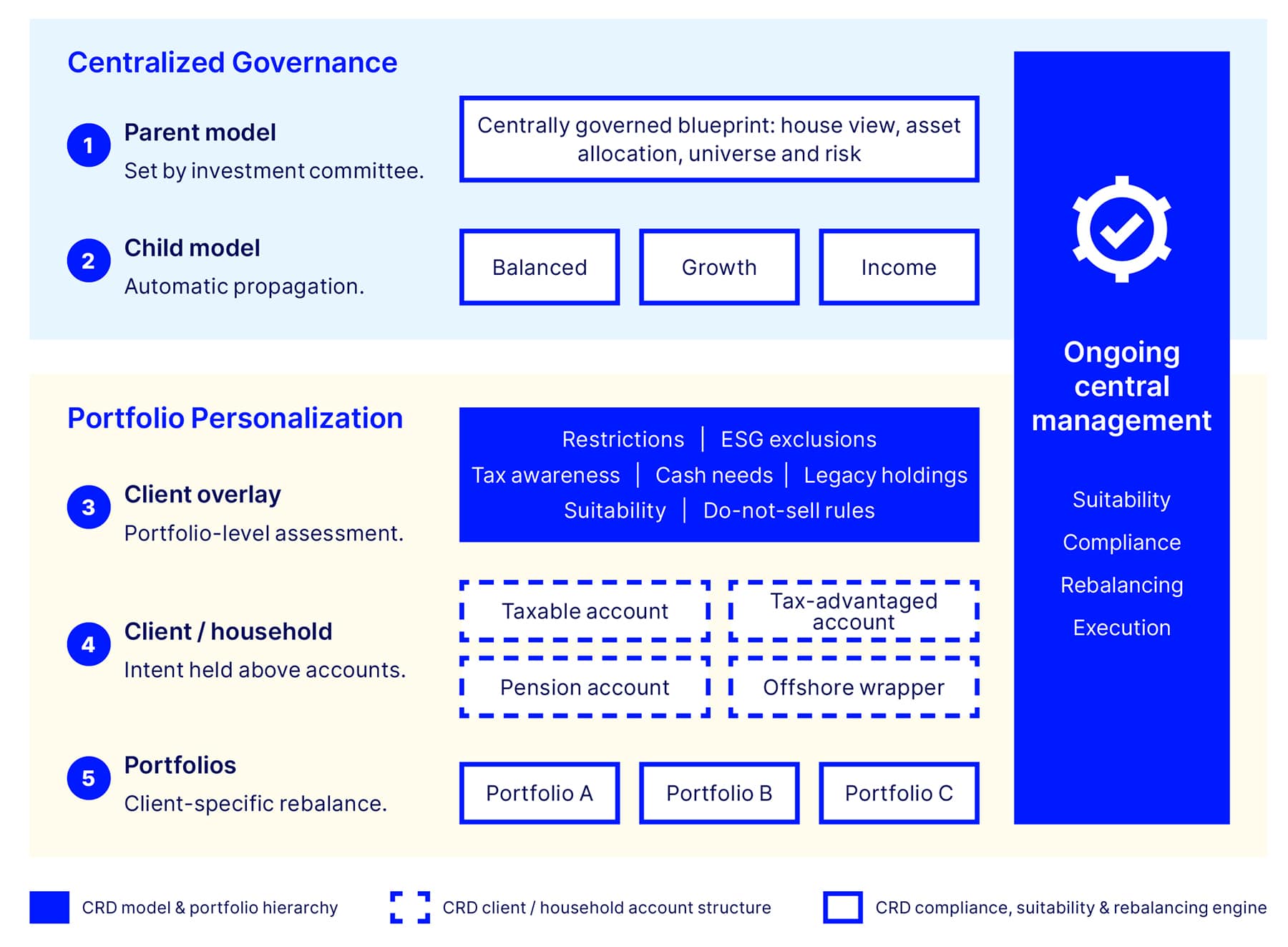
- Parent models: Central investment strategy
In Charles River, the central investment strategy is expressed through parent models, where strategic asset allocation, approved investment universes, risk tolerances and investment objectives are maintained centrally. Changes can be made once at the parent model level and then propagated automatically to linked child models, ensuring investment decisions are implemented consistently while maintaining a controlled and auditable governance framework. - Child models: Governed investment propositions
Child models translate the central investment strategy into governed investment propositions, for example risk profiles, mandate types, or client segments. This enables firms to adapt a common house view while maintaining consistency, governance and oversight across multiple offerings. - Client overlays: Portfolio-level personalisation
Client overlays apply portfolio-level personalisation through governed rules rather than manual intervention. Client-specific restrictions, ESG exclusions, tax awareness, cash needs, legacy holdings and suitability requirements are applied through the firm’s compliance and rebalancing rules, within the central investment framework. - Client / household: Governed implementation across accounts
Investment intent is held at client or household level, above the individual accounts. Charles River applies decisions consistently across taxable, tax-advantaged and pension accounts and offshore wrappers while respecting the rules of each. Where an account holds several strategies, it is divided into sleeves. - Ongoing central management through rebalancing, compliance and suitability controls
Portfolios remain subject to centralised oversight through automated rebalancing, compliance monitoring, suitability controls and integrated execution. Because suitability and compliance checks are applied to every rebalance and every decision to trade, a single investment decision can be propagated across thousands of portfolios and accounts while implementation remains aligned with both the investment strategy and client-specific requirements.
Conclusion: Personalisation through governance
Centralised investment governance with portfolio-level personalisation provides a common framework for delivering personalised investment services across the wealth spectrum without sacrificing governance, consistency or scale. By separating investment governance from portfolio implementation, firms can manage investment strategy, risk and oversight centrally while personalising portfolios to the needs, preferences and constraints of individual clients.
With Charles River, a single investment and governance framework can support varying levels of personalisation across client segments, enabling governed personalisation for HNW clients and scalable personalisation for the mass affluent. The technology is designed to operate at scale, supporting large volumes of accounts while maintaining consistency, governance and oversight.
The result is an operating model that combines personalisation, governance, automation and scale. As client expectations continue to rise and firms face increasing pressure to demonstrate suitability, value and operational efficiency, the traditional trade-off between personalisation and scale becomes increasingly difficult to sustain. Charles River already supports over $3 trillion of discretionary assets globally across more than 40 clients, demonstrating that this model can operate at scale. Those firms that can industrialise personalisation while keeping investment decisions and oversight central will be best positioned to capture the next phase of growth in wealth management.


Read All Insights
Contact Us
To learn more about Charles River Wealth Management Solutions or to schedule a demo.
9183053.1.1.GBL.
The material presented is for informational purposes only. The views expressed in this material are the views of the author, and are subject to change based on market and other conditions and factors, moreover, they do not necessarily represent the official views of Charles River Development and/or State Street Corporation and its affiliates.